


The provisional 2026 rulebook for GLTC was released on Wednesday to very little fanfare. I'm not racing with Gridlife next year, so I won't harp on the class too much more, but I wanted to put the scattered thoughts I've talked with others about into one post.
The TL;DR version of the rules update is: they lopped off the top of the class, and not much else. Let's get into it.

And in case you are interested, last season's rules are here, and for the 2026 provisional sporting regulations are here.
The changes in each document are red-lined, so it's easy to see what they changed.
Power Brackets Remain (Ugh)
In a baffling move, they've tripled down on the "bracket" method, which aims to create "parity" across the 12.5:1 power-to-weight ratio class. They have outright banned anything above 235whp, severely de-incentivized running above 230whp (there is a 4% penalty for each additional horsepower above 230whp), and imposed heavier-than-ever penalties for being "flat tuned for more than 1,500 rpm."
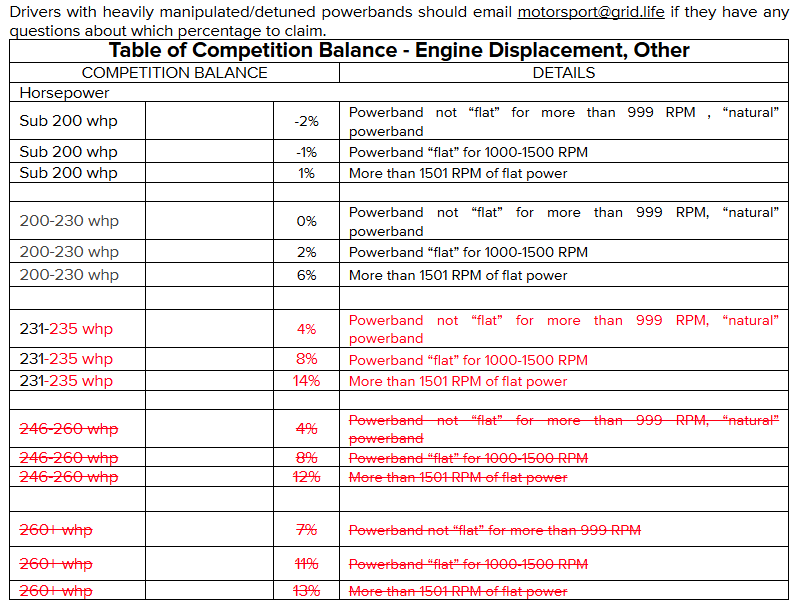
It is ridiculous to limit a 12.5:1 class to 235whp. Even accounting for the 4% penalty for running a 235whp natural powerband, this is only a 3,055lb competition weight, a weight many cars struggle to achieve.
There would be better ways to limit Corvettes or V8s if that is the end goal. Even with Gridlife now having a faster, higher-horsepower class (GLGT), there will be cars that are no longer GLTC legal but would not be remotely competitive in GLGT (because they cannot make 325+whp).
I'll cut to the chase and say that creating a reasonably broad average horsepower calculation would be the only way to fairly achieve what they are attempting to accomplish with this step-ladder bracket system, which lacks sufficient resolution and balance.
If you must tack on a few percentage-point adjustments to the average to account for things like powerbands that are flat for 4,000 RPM, just do that. Don't say that running in between 200-230whp (a 30 whp range!) is all "free" (0%, 2%, 6%), but if you cross a somehow magical threshold to 231whp, you must add 120-240lbs of ballast (4%, 8%, 12%). This is inane.
Individual Car BoP
If I am reading this rule correctly, they added the ability to penalize individual cars (BoP). I don't read this to mean a specific platform (like all E36 M3s), but rather one particular car at a time.
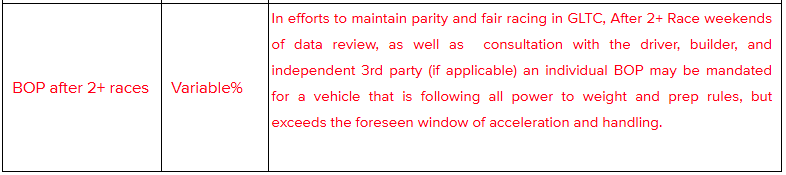
It could certainly end up arbitrary and opaque, like many sporting-related decisions in the past. The first few of these that get handed down are going to cause an uproar.
Tire Chart Updates (Insufficient)
Continuing with lopping off the top of the class, they removed the top two tire sizes (295 and 305), and made all cars above 2,976lbs run a maximum 275-width tire. This is a good move in principle, but it still leaves a couple of glaring errors.
First, they did nothing to prevent cars weighing well under 2,725lbs from running up to a 245-width average. For example, a 2,400lb front wheel drive car can legally run 265 front tires and 225 rear tires, which is a clear advantage for the few cars that can benefit from its exploitation.
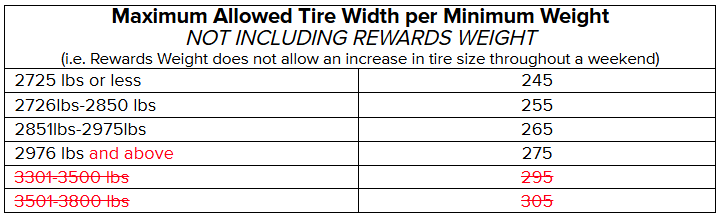
Second, the rule still relies on the stamped numbers on the tire, which we all know are made up. [i.e., all Falkens run a full size wider than the same width Kumho.] Measuring tire width with a template is not hard, people.
Other Random Changes
Automatic/PDK/DSG/DCT transmissions were penalized by an additional 2%, up to 4% to match sequentials. I don't know the data behind this to see whether it's fair, but I assume many modern OEM computer-shifted setups are very good.
You have to cover up decals from other series.
Dyno compliance runs will now be run with the hood open.
The maximum "rewards weight" was increased from 5% to 8%.
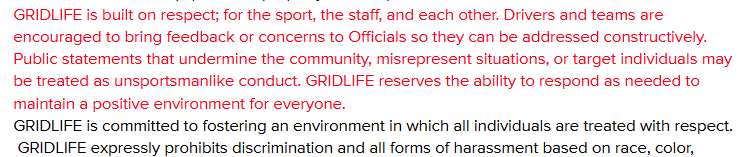
Talking publicly about the series in a negative light may be treated as unsportsmanlike conduct. Good thing nobody reads my blog.
That's All, Folks
Really, that's all the rule changes.
Where is the disconnect?
The few changes made are so out of touch with what the majority of the class wants for the series that I can only surmise one of these two things: 1) a select few people have outsized influence on the rules, and/or 2) the rules creators think that we're all idiots.
Many conversations I've had throughout this season have agreed that the series is not beyond saving. Yet, it will take decisive leadership and a stronger, more comprehensive rulebook to bring it back into line. This series, for all its good vibes and camaraderie, has outgrown its simplistic, well-intentioned, but ineffective rulebook.
Nothing Was Done to the Bottom or Middle
This season was dominated by cars on opposite ends of the rules: lightweight, low-power cars and heavyweight, high-power cars. The middle (power and weight) cars got lost in the mix.
With these rule updates, all they did was throw the high-power cars out with the bathwater. Nothing was done to rein in cars exploiting the low end of the rules, nor to help the middling mid-weight and mid-power cars.

Since two-time champion Matan Rosenberg isn't coming back, and third-place Eric Magnussen's car was further hampered, I'll go ahead and congratulate Eric Kutil on winning the 2026 championship. His car (with his driving) is going to dominate.
In Summary: Apathy
The proposed rules are supposedly open for feedback and discussion. Unfortunately, a lot of us have run out of breath and desire to keep fighting for change that never comes. It seems that we may not be as well-suited for this class as we once imagined.
✌️


Let's drive faster together