


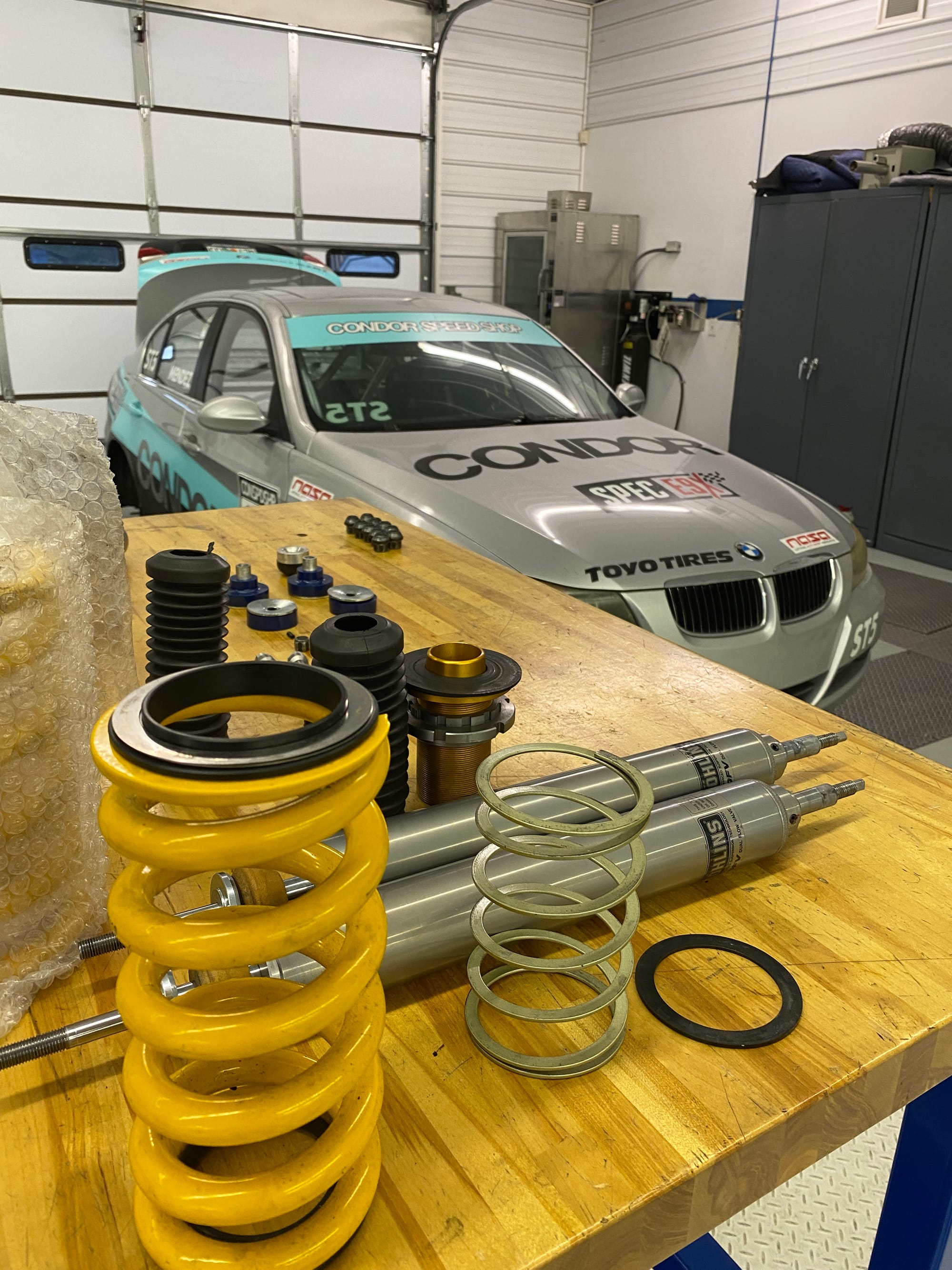
This is a deep dive into the Öhlins Spec E9X dampers. Since the kit's development in 2021, I've regularly driven and tinkered with the setup, and I've always been impressed by the value this suspension offers. Even if you don't race in the class, you will find the results and analysis interesting.
It was a conscious decision by the series to go with a "higher end" damper package, after nearly a decade dealing with the basic Bilstein Sport + lowering spring (and later, Ground Control coilover conversion) setup used by the Spec E30 series. The Öhlins Spec E9X kit is not top-tier motorsports hardware, but the quality and execution are several steps above your entry-level damper kits and Taiwanese coilover designs.
Öhlins is best known for its Road & Track kits that utilize its DFV technology and top-of-the-line TTX twin-tube motorsport dampers, which are rivaled only by Penske & similar. The Spec E9X kit is closer in design and hardware to the Road & Track and Dedicated Track kits, but with custom valving and spring rates developed specifically for the Spec E9X chassis and class.
You can learn more about Öhlins DFV technology here and Öhlins' product lineup here. This video covers DFV tech and shows the first Spec E9X build on the shaker rig.
Development Process
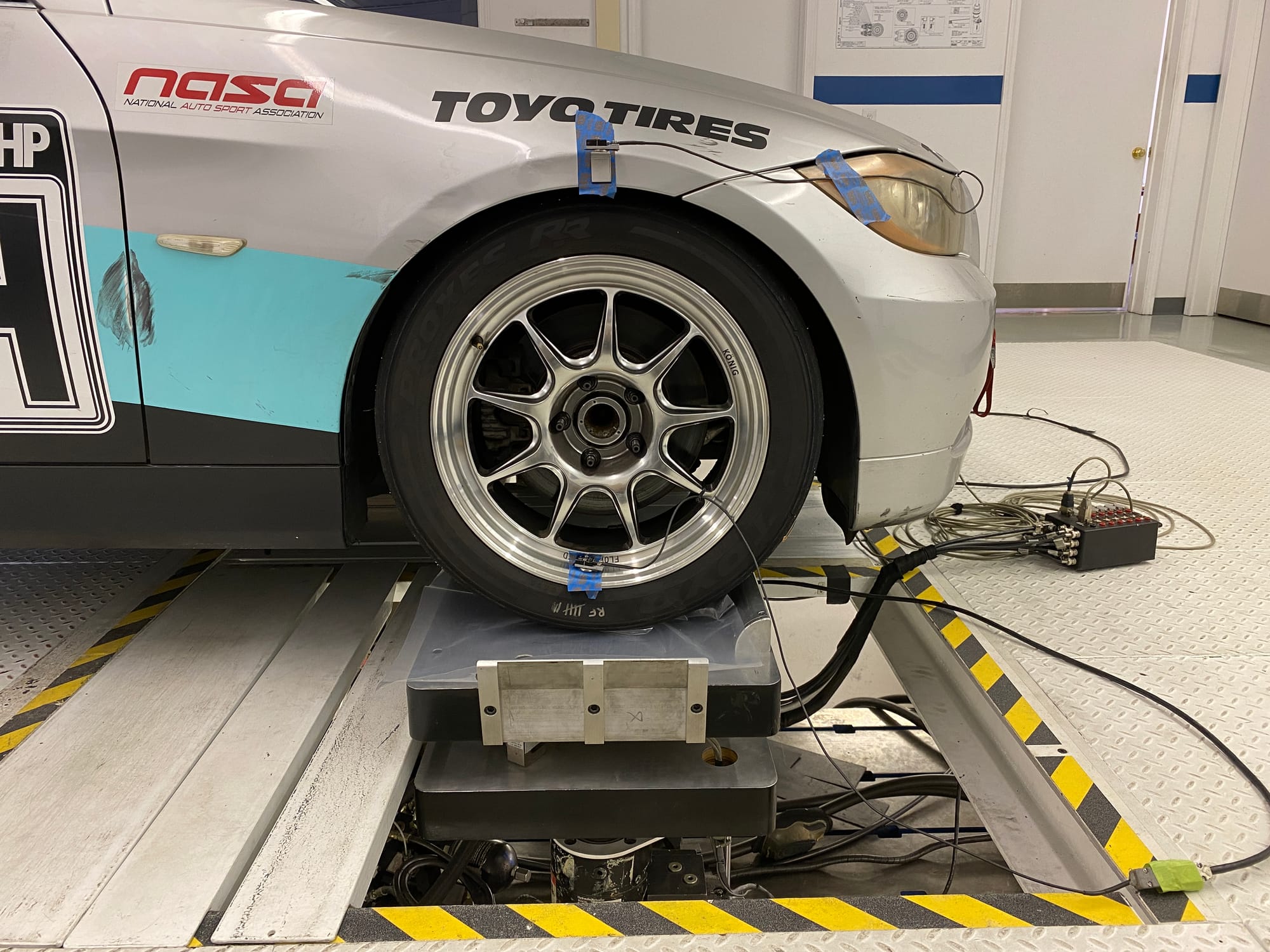
The Spec E9X dampers were custom-developed in North Carolina over a 4-month period. Öhlins USA's 7-post shaker table rig was utilized, along with expertise from Barry Battle of 3DM Suspension. The shaker rig was an indispensable part of the development process.
"Various tests can be performed from simple increasing frequency and amplitude oscillation tests, to exact duplication of tracks from around the world. The control computer uses various data sources and controls the impulse forces to each of the rigs 7 individually controllable hydraulic actuators. Sensors mounted on the chassis monitor the vehicle's dynamics and its reactions to the inputs.
Through careful analysis of the collected data, it is possible to tune the suspension setup, finding out what works and what does not work. Up until about 5 years ago, the only teams in the US that typically used these tests were NASCAR, CART or IRL teams due to the cost." -Racers Edge Inc.
Adjustability & Baseline Settings
The dampers are single-adjustable, with the adjustment knob affecting both compression and rebound damping simultaneously (but not equally, as we'll discuss below).
Öhlins counts damper clicks from full-stiff (fully clockwise). For instance, "5 clicks" means 5 clicks softer than full-stiff. It is important to pay attention to this, as many other dampers measure from full-soft.
The dampers have a total of 30 adjustment clicks.
Öhlins Official Baseline:
Front: 8 Clicks
Rear: 8 Clicks
The RISING EDGE-recommended baseline settings will be shared below after we look at the damper plot data.
The instruction manual for the kit can be downloaded using the link below.
Tech-y Stuff: Shock Plots
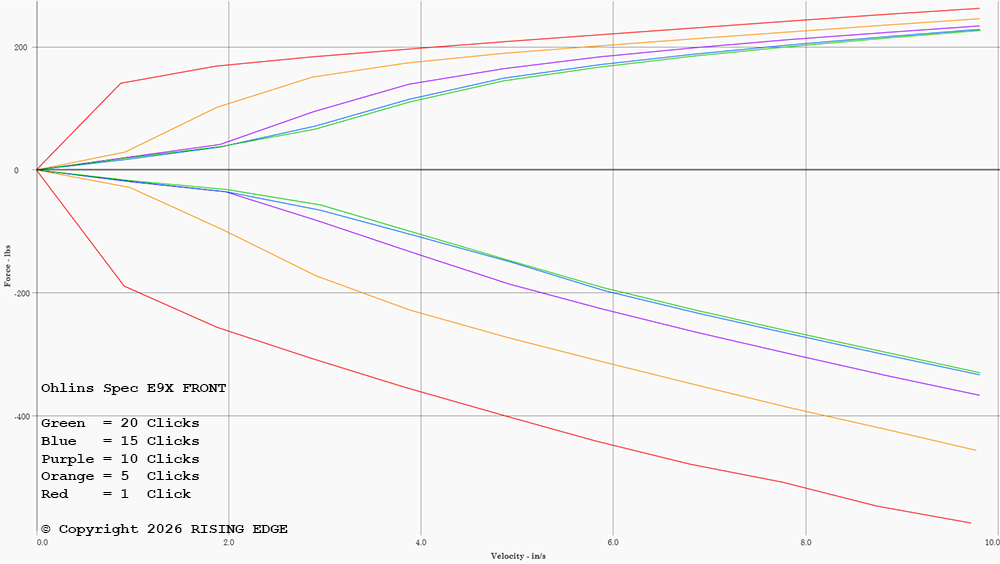
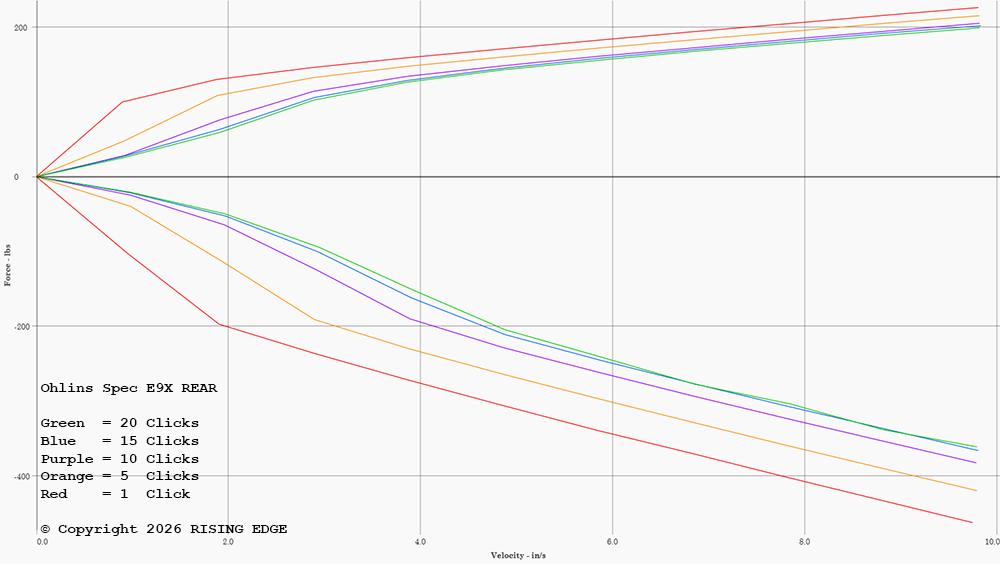
These are basic peak velocity plots (PVP) showing force versus shaft velocity. The lines are averages and give you an idea of how the damper forces change with different click settings.
Positive values (above 0) are compression forces, and negative values (below 0) are rebound forces.
The color codes are the same on each graph, and are as follows, from softest to stiffest:
| Color | Clicks |
|---|---|
| Green | 20 Clicks |
| Blue | 15 Clicks |
| Purple | 10 Clicks |
| Orange | 5 Clicks |
| Red | 1 Click |
Front Sweep
Rear Sweep
Critical Analysis
While the click changes affect both compression and rebound, they influence rebound more than compression. Compression forces are more affected in the low-speed range, while high-speed compression remains relatively grouped. Rebound forces are affected about equally at low and high speeds.
Low-speed velocities are steady-state cornering and slow transitive weight shifts. High-speed forces are large bumps and curb strikes.
The adjustment range is not linear. The changes are so subtle near the soft end of the spectrum that anything south of about 10 clicks from stiff is not worth bothering with. Observe that the change between 10 and 15 clicks is minimal, and between 15 and 20 clicks is almost nonexistent. It was not worth testing anything softer.
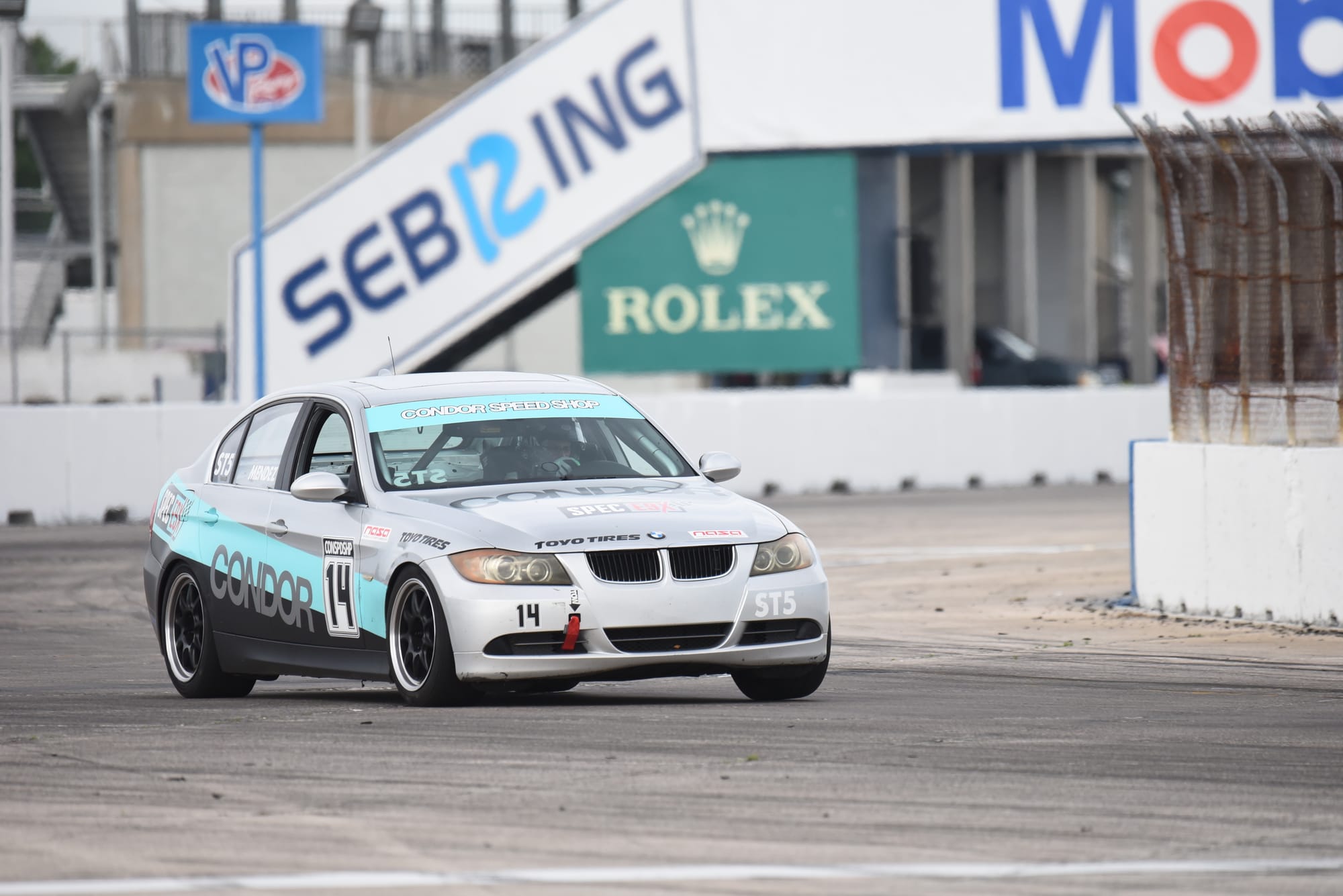
The dampers have a lot of high-speed rebound, which means that turning them too stiff can adversely affect the tire's ability to follow the surface on bumpy surfaces. Examples: sawtooth curbs/gators. and rapidly changing surfaces and bumps, such as most of Sebring Raceway.
The front rebound damping, in particular, gets a little crazy at the stiffest settings.
Adjustment Recommendations
After analyzing the data, we drew the following conclusions, along with some generalized setup and adjustment recommendations.
RISING EDGE Baseline
Front: 6 clicks
Rear: 5 clicks
Front working range: 3-9 clicks
Rear working range: 2-8 clicks
Clicks 1 and 2 can work in extreme situations and on smoother surfaces, but use with caution. Anything softer than about 10 clicks will not be necessary for track use.
Generalizing Broadly
- If the car feels like it's bouncing around, try a few clicks stiffer.
- If the car feels like it's skipping across the surface (not refering to traction loss or tire slip), try a few clicks softer.
- Front and rear transitive balance can be fine tuned by adjusting only one end of the car.
- In example, softening the front dampers might help turn in and mid-corner, at the expense of corner exit steering.
- Tire pressures, sway bar settings, and rake changes might be the safer bet, depending on which phase of the corner you are targeting.
Closing Thoughts
Hopefully, this article has provided you with useful insight into setting up and fine-tuning your Ohlins Spec E9X dampers. Within the recommended working range of clicks, even just one or two clicks should make a tangible difference in the car's behavior.
Stick with Ohlin's recommended service intervals, and your investment in this quality damper kit will last the lifetime of your race car.
For additional setup recommendations and consultation, contact us.
Special thanks to Ken Houseal of Phased Approach for helping to analyze the shock plots and peer-reviewing my analysis. Additional thanks to Condor Speed Shop and 3DM Suspension for the damper test data.


Grassroots racing, properly overthought.